Back
Knowledge Panel for Fund Managers: Owning Your Search Result Before LP Diligence Begins
Allocators read your search result before they read your deck.
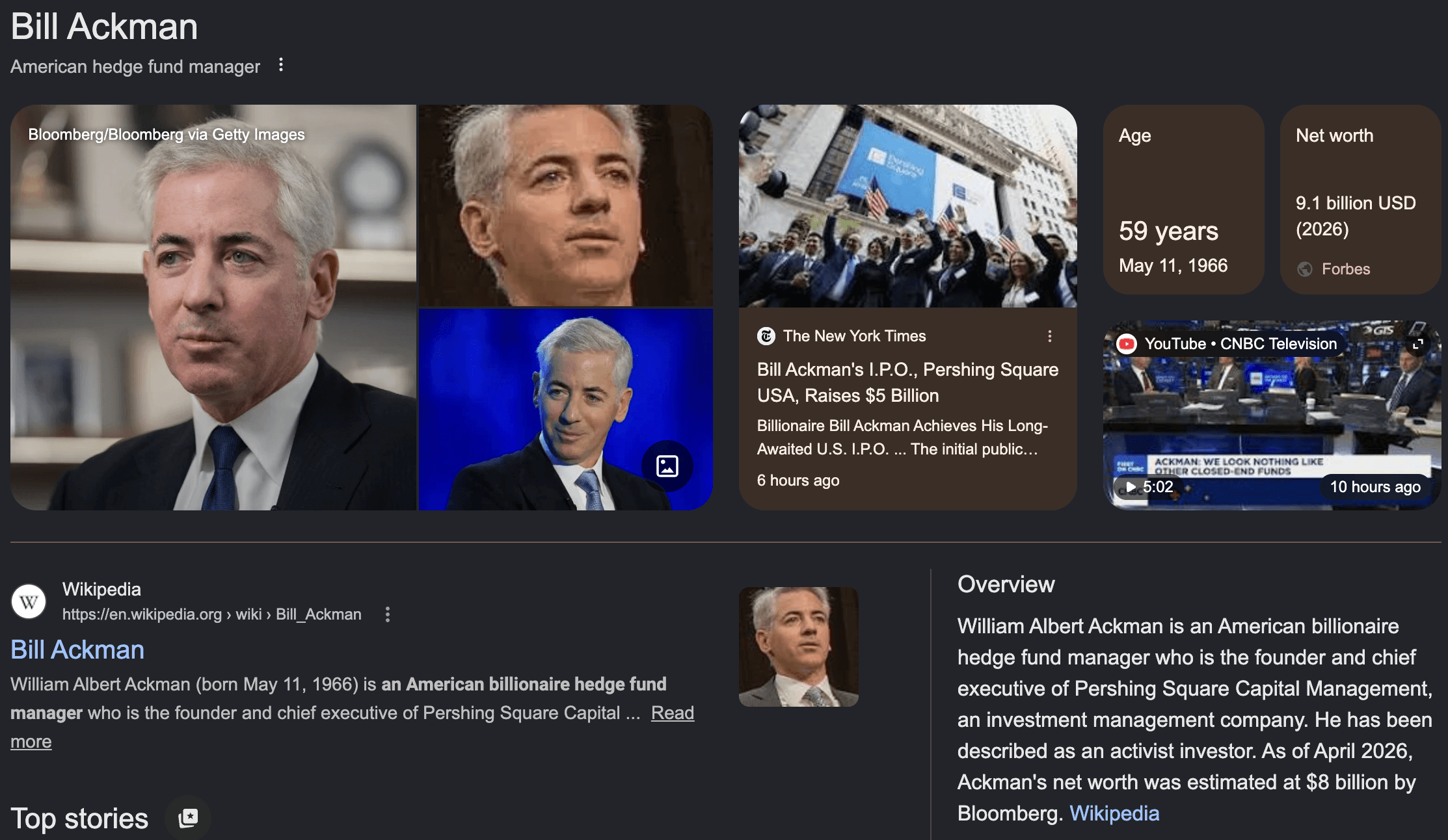
When a family office, institutional LP, or HNW allocator gets your name from a referral, they google you before they open the data room. That search is the first diligence document. If it shows SEC filings, a stale LinkedIn page, and a PitchBook entry that frames you as a row in someone else's database, you've lost the controlled narrative you spent five years building.
LP diligence patterns are well-documented. Preqin, Cerulli, and ILPA reporting consistently show institutional and HNW allocators conduct extensive online research on GPs before any operational diligence call. For family offices and HNW allocators specifically, the GP's personal credibility often outweighs the deck. The decision to take the second meeting is shaped on the SERP.
A Google Knowledge Panel is the verified card on the right side of search. Title, firm, education, key social profiles, "people also search for." It's pulled from Google's Knowledge Graph, which spans more than 500 billion facts across 5 billion entities. When Google decides you are a verifiable entity, the panel appears. When it doesn't, your LP's first impression is fragmentation: SEC filings, a LinkedIn link, and someone else with your name.
What fund managers typically lose on the SERP
SEC filing dominance. Form ADV, Form D, and EDGAR pages outrank your firm site. The first page becomes a regulatory document instead of a credibility document.
Database framing. PitchBook, Crunchbase, and Bloomberg-derived profiles control how you and the fund are described. None of them are owned by you.
Multi-entity drag. You as a person, the GP entity, the management company, the fund vehicles, the portfolio companies. Without consolidation, Google sees five loose entities and triggers panels for none.
Each costs you the diligence step. Allocators who can't stitch you into a coherent identity assume risk that wasn't there.
What changes once your panel is live
Verified card. Role, firm, education, key links. SEC filings drop down in the SERP.
Multi-entity consolidation. You, the GP, and the fund get linked into one identity graph Google can read.
"People also search for" places you among peer GPs Google considers comparable. For emerging managers that's positioning; for established GPs, reinforcement.
Composite queries ("[your name] hedge fund," "[your name] partner [Firm]") return panel-led results.
The panel doesn't replace your IR materials, DDQ, or data room. It frames how all of them get read.
How Lindy builds it
We pull a confidence score from the Knowledge Graph API to baseline what Google currently understands about you. We then engineer the missing signals: home-base structured data, citation graph reinforcement across press and authoritative finance sources, social profile alignment, schema markup, and entity consolidation across the fund stack.
Stage 1 panel (mini card) in 15 to 20 business days.
Stage 2 panel (full feature set) within 2 to 2.5 months.
Disambiguation cases (common name, competing GP, name shared with a public figure) extend to 3 to 4 months.
For managers running multiple entities (you, the GP, the fund, related vehicles), parallel builds run concurrently and bundle. You become the verified manager. Lifetime optimization covers role changes, fund launches, and any item inside the panel that needs adjustment later.
Compliance and discretion fit
Knowledge Panels surface neutral entity information already public elsewhere: title, firm, education, social. No performance claims, no AUM claims, no testimonials. They fit cleanly inside the SEC marketing rule and equivalent constraints in other jurisdictions.
For managers who prefer minimal visibility, the panel can be kept lean: title, firm, one social link, nothing else. DOB, place of birth, and education are all optional. Discretion and verification aren't opposites. The panel exists to verify the entity Google is already trying to render, not to add visibility you don't want.
When this is worth doing
You're actively raising. You sit at the center of a multi-entity stack. You speak publicly or write under your byline. Your LPs include family offices and HNWIs whose allocation decision is partly a personal credibility decision.
It is not worth doing if your fund is pre-launch with no AUM, no press, and no public posture. We'll tell you that on the call.
FAQ
Q: Will this affect my Form ADV or SEC filings?
No. The panel is a separate Google surface and shows only public, neutral information. SEC filings are unaffected.
Q: I run on a discretion-first mandate. Should I still do this?
Often, yes. A minimal verified panel is more discreet than a fragmented SERP that includes someone else with your name. You control every field shown.
Q: Can you panel my fund or management company as a separate entity?
Yes. Personal panels and company panels are complementary. Multi-entity engagements run in parallel and bundle.
Q: What if my name is shared with another fund manager?
Variant strategy plus corroboration across press, LinkedIn, fund site, and structured data. Longer timeline, same scope.

Abhay Jain
Founder
Latest posts
Discover other pieces of writing in our blog