Back
Back
Google Knowledge Panel for Influencers and Creators
For influencers and creators, your Google name search now does more for brand trust than any platform badge or follower count.
Dec 7, 2025
Influencers, Your Name Search Is The Real Blue Tick
For years, the primary status symbol for an online creator was the blue checkmark. Verified badges on social platforms acted as shorthand for legitimacy. They told followers and brands that you were who you claimed to be.
As verification has become easier to buy or game, that badge means less. The deeper trust check has quietly moved to a place that has always been there. The Google search box with your name in it.
If you earn a living through attention, sponsorships, or selling products to your audience, the page that appears when someone searches your name is not a vanity mirror. It is part of your sales funnel.
What brands and strangers actually do before they wire you money
A brand manager sees your metrics, likes your content, and wants to explore a collaboration. A new follower is considering buying your course or joining your community. A podcast host is thinking about inviting you as a guest. In all of those scenarios, the next step is very often the same. They search your name on Google.
If what they see is a pile of random accounts, repost channels, gossip threads, and fan made pages, they have to work to figure out which version of you is real. That work feels like risk. The brand manager starts to worry about fraud or controversy. The follower starts to wonder if you are stable enough to trust with their payment details and attention.
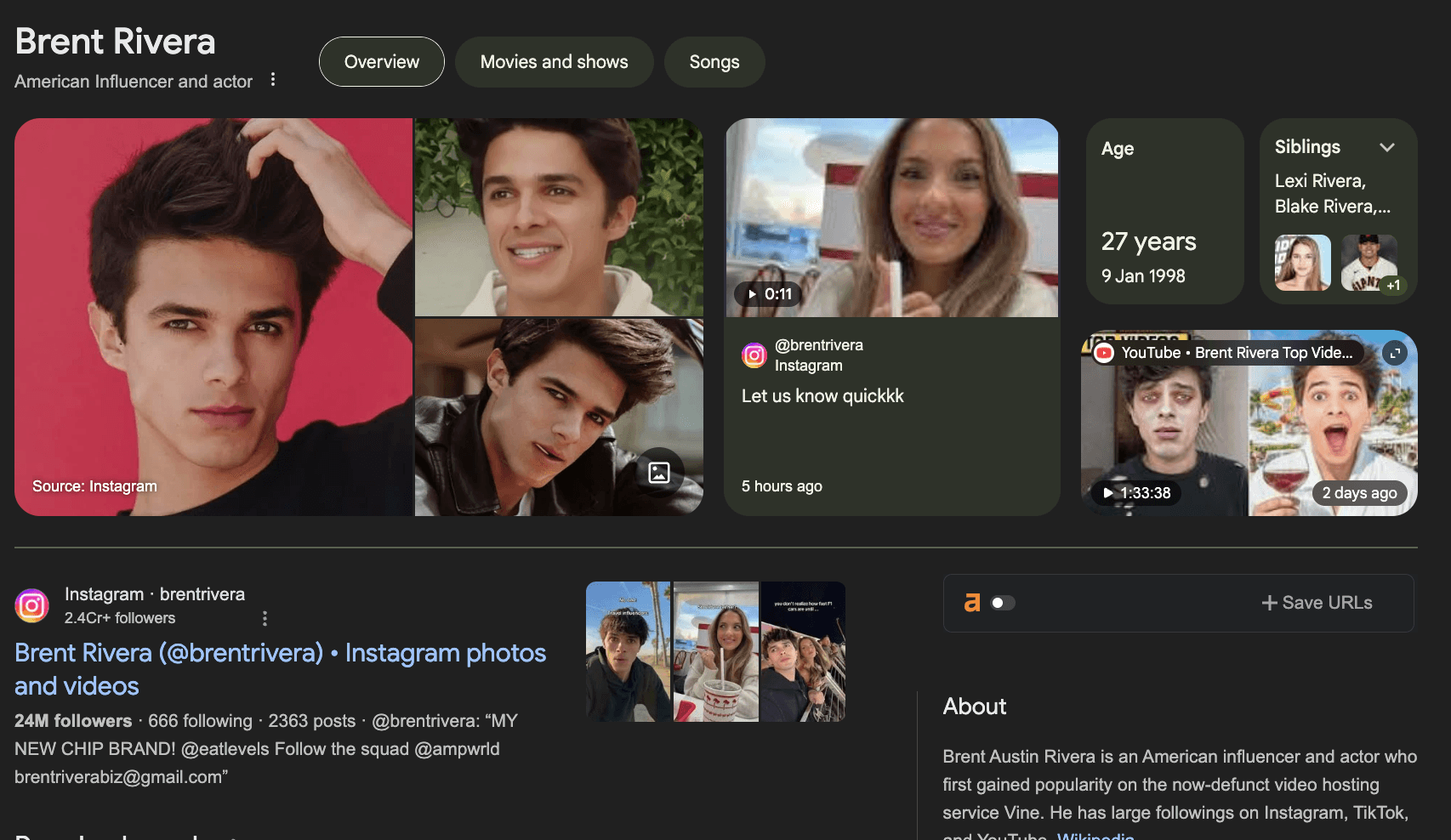
Now imagine that same search, but with a Knowledge Panel present. A panel that shows your name, your main role, a clean photo, and links to your official channels and site. That one box changes how the entire page feels. The chaos of search results becomes anchored by something that looks official, structured, and stable.
Find out if you are eligible for a Google Knowledge Panel here!
Why a Knowledge Panel matters even if your audience already trusts you
You might think that your followers already know who you are. They see your content daily, watch your stories, and interact with you on platforms that feel intimate. That is true at the core of your audience.
The people who question you are often one or two steps out from that core. The friend your follower wants to convince to buy your product. The manager who has to sign off on a brand deal. The journalist who saw you go viral once and wants to know if you are a one off. Those are exactly the people who are most likely to use Google as their first filter.
A Knowledge Panel is a signal aimed at the edge of your reputation, not the center. It tells people who barely know you that there is enough consistent information about you in the wild for Google to summarise you with confidence. That is a very different impression than a search page where your identity is mostly defined by gossip sites or third party aggregators.
The difference between social clout and machine legibility
The creator world is full of visible signals. Follower counts, view numbers, engagement screenshots. These are important within the platforms themselves, but they are not the only signals that matter in a broader sense.
From the perspective of search engines and AI models, what counts is whether you are an entity that can be reliably understood. That involves:
Consistent naming across platforms and publications
High quality sources that mention you in a factual way
Structured data that links those mentions to the same person
A clear separation between you and other people who share your name
When those conditions are met, systems like Google promote your presence into a Knowledge Panel. That panel then becomes part of the raw material that other tools pull from when they answer questions about you.
In other words, your Knowledge Panel is not competing with your follower count. It is operating in a different layer. The infrastructure layer that takes you from being a social media page to being a documented figure in the wider information graph.
Why some very small artists have panels and some big creators do not
If you have ever searched for an obscure musician or writer and seen a surprisingly detailed panel, you have already seen this effect. A niche band with a tiny audience can have a full panel with albums and tour dates, while a creator with millions of followers has nothing similar.
This happens because the musician’s presence fits the pattern the system expects. They have releases on platforms tied to databases, structured metadata, and consistent mentions on high trust sites. The creator, meanwhile, may have explosive reach on a single platform but very little structured, off platform information.
The lesson here is not that one deserves it more than the other. It is that popularity and machine legibility are different things. As a creator, you are now operating at the intersection of both.
Turning your name into a durable asset
Your content, audience, and revenue are already proof that you exist in the attention economy. The question is whether your name is also anchored in the slower, more durable information economy.
Building toward a Knowledge Panel is one way to do that. It forces you to:
Align your public bios and profiles so they tell one coherent story
Create or support a small number of high trust references that describe you accurately
Clean up confusions where your name is linked to things you do not control
Once the panel exists, it becomes part of the background infrastructure that supports everything you do. New followers, brands, and collaborators see the same, stable introduction every time they search you.
In a world where verification on social platforms is cheaper and noisier than ever, the Google Knowledge Panel is starting to look like the real underlying badge. It is not flashy. It simply sits there and quietly tells everyone, human and machine, that you are a real person with a traceable presence.
For a creator or influencer who plans to be around for a long time, that quiet stability is worth a lot more than it looks at first glance.
Influencers, Your Name Search Is The Real Blue Tick
For years, the primary status symbol for an online creator was the blue checkmark. Verified badges on social platforms acted as shorthand for legitimacy. They told followers and brands that you were who you claimed to be.
As verification has become easier to buy or game, that badge means less. The deeper trust check has quietly moved to a place that has always been there. The Google search box with your name in it.
If you earn a living through attention, sponsorships, or selling products to your audience, the page that appears when someone searches your name is not a vanity mirror. It is part of your sales funnel.
What brands and strangers actually do before they wire you money
A brand manager sees your metrics, likes your content, and wants to explore a collaboration. A new follower is considering buying your course or joining your community. A podcast host is thinking about inviting you as a guest. In all of those scenarios, the next step is very often the same. They search your name on Google.
If what they see is a pile of random accounts, repost channels, gossip threads, and fan made pages, they have to work to figure out which version of you is real. That work feels like risk. The brand manager starts to worry about fraud or controversy. The follower starts to wonder if you are stable enough to trust with their payment details and attention.
Now imagine that same search, but with a Knowledge Panel present. A panel that shows your name, your main role, a clean photo, and links to your official channels and site. That one box changes how the entire page feels. The chaos of search results becomes anchored by something that looks official, structured, and stable.
Find out if you are eligible for a Google Knowledge Panel here!
Why a Knowledge Panel matters even if your audience already trusts you
You might think that your followers already know who you are. They see your content daily, watch your stories, and interact with you on platforms that feel intimate. That is true at the core of your audience.
The people who question you are often one or two steps out from that core. The friend your follower wants to convince to buy your product. The manager who has to sign off on a brand deal. The journalist who saw you go viral once and wants to know if you are a one off. Those are exactly the people who are most likely to use Google as their first filter.
A Knowledge Panel is a signal aimed at the edge of your reputation, not the center. It tells people who barely know you that there is enough consistent information about you in the wild for Google to summarise you with confidence. That is a very different impression than a search page where your identity is mostly defined by gossip sites or third party aggregators.
The difference between social clout and machine legibility
The creator world is full of visible signals. Follower counts, view numbers, engagement screenshots. These are important within the platforms themselves, but they are not the only signals that matter in a broader sense.
From the perspective of search engines and AI models, what counts is whether you are an entity that can be reliably understood. That involves:
Consistent naming across platforms and publications
High quality sources that mention you in a factual way
Structured data that links those mentions to the same person
A clear separation between you and other people who share your name
When those conditions are met, systems like Google promote your presence into a Knowledge Panel. That panel then becomes part of the raw material that other tools pull from when they answer questions about you.
In other words, your Knowledge Panel is not competing with your follower count. It is operating in a different layer. The infrastructure layer that takes you from being a social media page to being a documented figure in the wider information graph.
Why some very small artists have panels and some big creators do not
If you have ever searched for an obscure musician or writer and seen a surprisingly detailed panel, you have already seen this effect. A niche band with a tiny audience can have a full panel with albums and tour dates, while a creator with millions of followers has nothing similar.
This happens because the musician’s presence fits the pattern the system expects. They have releases on platforms tied to databases, structured metadata, and consistent mentions on high trust sites. The creator, meanwhile, may have explosive reach on a single platform but very little structured, off platform information.
The lesson here is not that one deserves it more than the other. It is that popularity and machine legibility are different things. As a creator, you are now operating at the intersection of both.
Turning your name into a durable asset
Your content, audience, and revenue are already proof that you exist in the attention economy. The question is whether your name is also anchored in the slower, more durable information economy.
Building toward a Knowledge Panel is one way to do that. It forces you to:
Align your public bios and profiles so they tell one coherent story
Create or support a small number of high trust references that describe you accurately
Clean up confusions where your name is linked to things you do not control
Once the panel exists, it becomes part of the background infrastructure that supports everything you do. New followers, brands, and collaborators see the same, stable introduction every time they search you.
In a world where verification on social platforms is cheaper and noisier than ever, the Google Knowledge Panel is starting to look like the real underlying badge. It is not flashy. It simply sits there and quietly tells everyone, human and machine, that you are a real person with a traceable presence.
For a creator or influencer who plans to be around for a long time, that quiet stability is worth a lot more than it looks at first glance.
Influencers, Your Name Search Is The Real Blue Tick
For years, the primary status symbol for an online creator was the blue checkmark. Verified badges on social platforms acted as shorthand for legitimacy. They told followers and brands that you were who you claimed to be.
As verification has become easier to buy or game, that badge means less. The deeper trust check has quietly moved to a place that has always been there. The Google search box with your name in it.
If you earn a living through attention, sponsorships, or selling products to your audience, the page that appears when someone searches your name is not a vanity mirror. It is part of your sales funnel.
What brands and strangers actually do before they wire you money
A brand manager sees your metrics, likes your content, and wants to explore a collaboration. A new follower is considering buying your course or joining your community. A podcast host is thinking about inviting you as a guest. In all of those scenarios, the next step is very often the same. They search your name on Google.
If what they see is a pile of random accounts, repost channels, gossip threads, and fan made pages, they have to work to figure out which version of you is real. That work feels like risk. The brand manager starts to worry about fraud or controversy. The follower starts to wonder if you are stable enough to trust with their payment details and attention.
Now imagine that same search, but with a Knowledge Panel present. A panel that shows your name, your main role, a clean photo, and links to your official channels and site. That one box changes how the entire page feels. The chaos of search results becomes anchored by something that looks official, structured, and stable.
Find out if you are eligible for a Google Knowledge Panel here!
Why a Knowledge Panel matters even if your audience already trusts you
You might think that your followers already know who you are. They see your content daily, watch your stories, and interact with you on platforms that feel intimate. That is true at the core of your audience.
The people who question you are often one or two steps out from that core. The friend your follower wants to convince to buy your product. The manager who has to sign off on a brand deal. The journalist who saw you go viral once and wants to know if you are a one off. Those are exactly the people who are most likely to use Google as their first filter.
A Knowledge Panel is a signal aimed at the edge of your reputation, not the center. It tells people who barely know you that there is enough consistent information about you in the wild for Google to summarise you with confidence. That is a very different impression than a search page where your identity is mostly defined by gossip sites or third party aggregators.
The difference between social clout and machine legibility
The creator world is full of visible signals. Follower counts, view numbers, engagement screenshots. These are important within the platforms themselves, but they are not the only signals that matter in a broader sense.
From the perspective of search engines and AI models, what counts is whether you are an entity that can be reliably understood. That involves:
Consistent naming across platforms and publications
High quality sources that mention you in a factual way
Structured data that links those mentions to the same person
A clear separation between you and other people who share your name
When those conditions are met, systems like Google promote your presence into a Knowledge Panel. That panel then becomes part of the raw material that other tools pull from when they answer questions about you.
In other words, your Knowledge Panel is not competing with your follower count. It is operating in a different layer. The infrastructure layer that takes you from being a social media page to being a documented figure in the wider information graph.
Why some very small artists have panels and some big creators do not
If you have ever searched for an obscure musician or writer and seen a surprisingly detailed panel, you have already seen this effect. A niche band with a tiny audience can have a full panel with albums and tour dates, while a creator with millions of followers has nothing similar.
This happens because the musician’s presence fits the pattern the system expects. They have releases on platforms tied to databases, structured metadata, and consistent mentions on high trust sites. The creator, meanwhile, may have explosive reach on a single platform but very little structured, off platform information.
The lesson here is not that one deserves it more than the other. It is that popularity and machine legibility are different things. As a creator, you are now operating at the intersection of both.
Turning your name into a durable asset
Your content, audience, and revenue are already proof that you exist in the attention economy. The question is whether your name is also anchored in the slower, more durable information economy.
Building toward a Knowledge Panel is one way to do that. It forces you to:
Align your public bios and profiles so they tell one coherent story
Create or support a small number of high trust references that describe you accurately
Clean up confusions where your name is linked to things you do not control
Once the panel exists, it becomes part of the background infrastructure that supports everything you do. New followers, brands, and collaborators see the same, stable introduction every time they search you.
In a world where verification on social platforms is cheaper and noisier than ever, the Google Knowledge Panel is starting to look like the real underlying badge. It is not flashy. It simply sits there and quietly tells everyone, human and machine, that you are a real person with a traceable presence.
For a creator or influencer who plans to be around for a long time, that quiet stability is worth a lot more than it looks at first glance.

Ready to look like someone who matters?
Turn your Google presence into a polished Knowledge Panel that signals credibility to clients, investors and press before you ever walk in the room.
Ready to look like someone who matters?
Turn your Google presence into a polished Knowledge Panel that signals credibility to clients, investors and press before you ever walk in the room.
Ready to look like someone who matters?
Turn your Google presence into a polished Knowledge Panel that signals credibility to clients, investors and press before you ever walk in the room.
Latest posts
Discover other pieces of writing in our blog