Back
Back
Getting a Google Knowledge Panel for an Artist
Why the Artist Google Knowledge Panel is a must!
Dec 8, 2025
For artists, the most valuable wall is no longer just in a gallery or museum. It is the page that appears when someone types your name into Google.
Curators, festival bookers, journalists, collectors, even other artists you want to collaborate with all do the same thing before they commit. They search your name. If that page looks chaotic, out of date or full of unofficial profiles, they have to work hard to decide who you are and whether you are worth the risk.
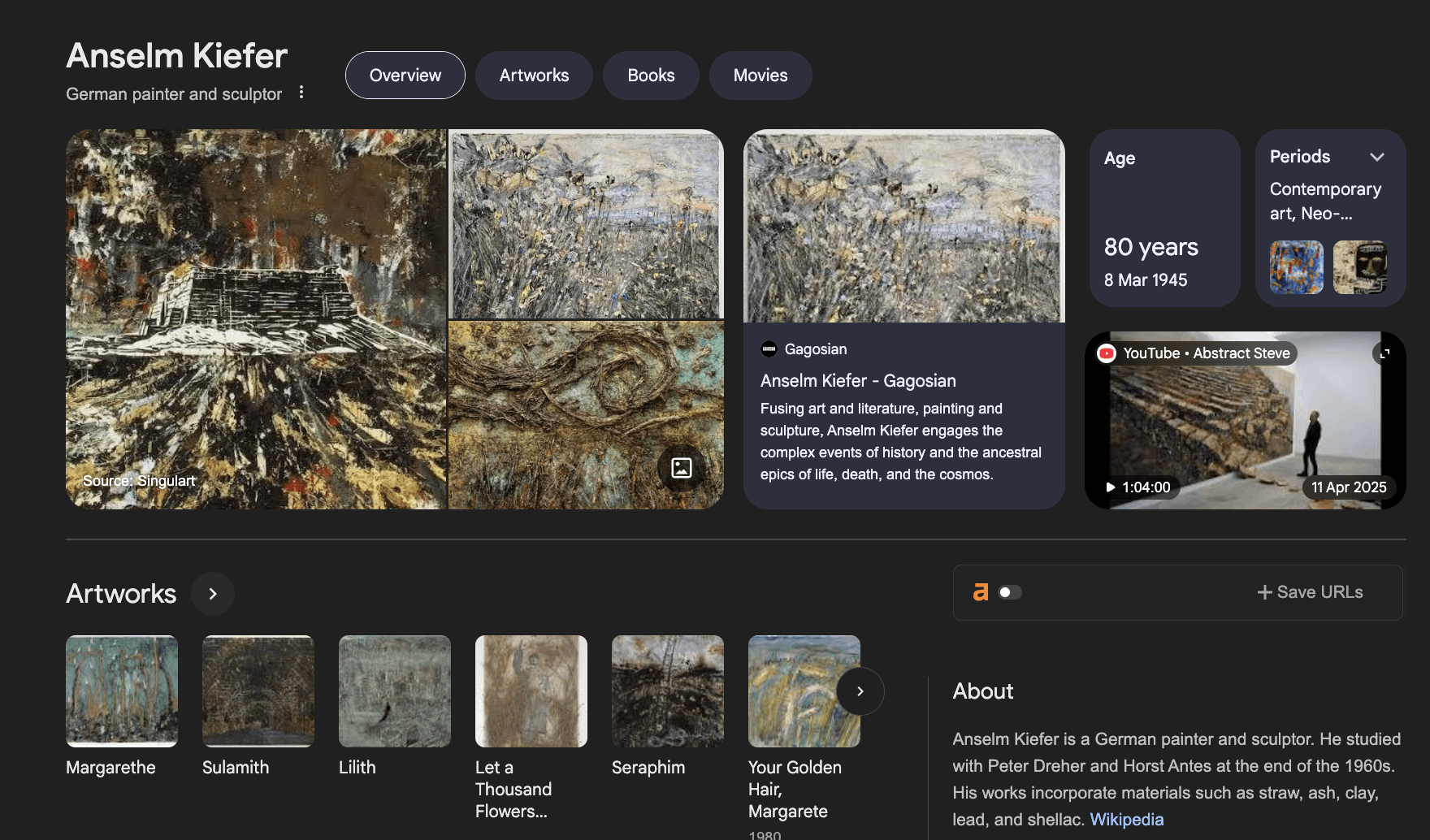
A Google Knowledge Panel changes that. It is the box on the right side of the results (or at the top on mobile) that treats you like an established entity: name, photo, discipline, notable works, official links, sometimes even a short description of your practice. It is the closest thing the internet has to a clean, framed artist label next to your name.
This article breaks down what a Knowledge Panel is, why it matters for artists specifically, and what actually moves the needle if you want to qualify for one.
Check if you are eligible for a Google Knowledge Panel here.
What is a Google Knowledge Panel for an artist?
At the technical level, a Knowledge Panel is Google’s way of saying:
“This is a real person or project that we understand as a distinct entity, and here is our best summary of the key facts about them.”
For an artist, that usually means:
Your full name and sometimes your primary discipline
(for example: painter, multimedia artist, singer songwriter, composer, photographer)A main image that acts as your “cover”
(portrait, performance photo, or representative work)A short description of who you are and what you are known for
Key facts such as date of birth, nationality, movement or genre
Links to your official website and high trust platforms
(gallery, label, Spotify, Apple Music, Bandcamp, Discogs, institutional pages, etc)Related entities such as bands you are part of, collectives, galleries, festivals or institutions that have worked with you
All of that is powered by Google’s Knowledge Graph under the hood. The panel is just the visible surface. When you earn one, you have effectively passed a quiet threshold: the system has enough confidence that you are a unique artist, not just a name collision.
Why a Knowledge Panel matters so much for artists
An artist lives and dies on context. The same painting looks different when it is hung in a museum versus a random café. The same is true for your name online. The context around it changes how seriously people take you.
A Knowledge Panel upgrades that context in a few important ways.
1. Instant credibility for gatekeepers
Curators, juries, festivals, grants, labels and agents get too many applications. Most of their due diligence happens on fast scans. They skim your portfolio, then they search your name.
A clean panel:
Confirms you are a real artist with a traceable history
Signals that respected institutions and platforms have already taken you seriously
Reduces the risk that they are mixing you up with someone else with the same name
Shows that your career is documented in more than one place
It does not replace your work. It frames it.
2. A gentle filter for collectors and patrons
Collectors, patrons and high net worth buyers behave the same way. Before wiring money or committing to commissions, they look you up.
If that page is a mix of old festival posters, random social profiles and a few pirated uploads on music sites, it feels messy.
If there is a clear, stable panel with:
A portrait
A concise description of your practice
Links to your official site and serious institutions
then the whole interaction feels safer. They might still have questions about price or availability, but they are not wondering where you came from.
3. Strong signal to journalists and press
Journalists work under time pressure. They often have to introduce you in a sentence or two. If they see a panel, they:
Get an instant baseline of verified facts
Feel more comfortable quoting your bio and milestones
Spend less time trying to piece together who you are from scattered links
Over time, that compounds. Better introductions become more consistent. Mislabelings and factual errors around your name decrease.
4. Downstream effects in AI and recommendation systems
As search shifts into AI summaries and recommendation feeds, the question quietly becomes:
“When a machine explains who you are, what template does it use?”
A recognised entity with a Knowledge Panel gives the system a much cleaner starting point than a random name plus a few unstructured mentions.
What makes an artist eligible for a Knowledge Panel?
There is no official checklist from Google, and there is no form you can fill that guarantees a panel. But from experience with hundreds of panels, there are clear patterns that help artists cross that threshold.
You can think about it in three layers.
1. Stable identity signals
Google needs to be sure that all the mentions it sees really belong to the same person.
That means:
Consistent artist name or stage name across platforms
The same spelling and punctuation
A clear connection between your legal name and artist name if they differ
A main “home base” website that confirms both
If half your profiles use one name and half use another, or if there are several other people with the same name in other fields, the system has less confidence and is slower to give you a panel.
2. High trust sources
Knowledge Panels do not appear because you made a lot of posts. They appear because the system sees you in what it considers high quality, structured contexts.
For artists, the kinds of sources that help include:
Institutional pages
Museum, gallery or festival sites with a proper artist page or exhibition listingMusic and performance databases
Spotify, Apple Music, Discogs, MusicBrainz, AllMusic, official label pagesAcademic and cultural institutions
University or conservatory pages, residency programs, funded projectsSerious media
Interviews, profiles or reviews in established publications
The more of these that exist and agree with each other, the easier it is for the graph to pin down who you are.
3. Coherent story across the web
You do not need a huge volume of content. You need a coherent pattern.
Things that help:
The same short bio across platforms, adjusted but not conflicting
Consistent genre or mediums listed
The same selection of “signature” works or projects mentioned repeatedly
Links that loop back to your official site rather than random hubs
From the machine’s point of view, coherence looks like truth.
How artists can set themselves up for a panel
You cannot buy a Knowledge Panel directly. You can, however, design your online presence so the Knowledge Graph has an easier job.
Here is what that looks like in practice.
1. Build a clear “home” for your practice
You should have one main place that states, beyond doubt: this is you.
Usually that is your own website, ideally on yourname.com or a strong domain connected to your studio or band.
On that site:
Publish a concise, well written artist bio
List your primary disciplines, genres and mediums
Display a small, curated selection of works or projects with dates and venues
Link out to your official profiles on high trust platforms
Include basic schema and structured data so machines can read it cleanly
Think of this as your central label. Everything else on the web should confirm what this page says.
2. Tighten up your core platforms
Pick the platforms that matter most for your discipline and make them consistent.
For example:
Music artists: Spotify, Apple Music, YouTube, Bandcamp, label site
Visual artists: gallery sites, Artsy, institutional exhibitions, residency pages
Theatre and performance: festival sites, company pages, major venues
On each one:
Use the same name and photo wherever possible
Keep the description aligned with your main bio
Link back to your official site
You are not posting for the algorithm here. You are aligning facts.
3. Make your serious wins easy to see
The Knowledge Graph gets more confident when important milestones are documented in traceable ways.
Examples:
Exhibition or show listings on well known institutions
Grants, prizes or residencies listed on official program sites
Festival performances that appear on the festival’s own website
Album or EP releases that appear on label pages and major music platforms
If you have these wins already but they are buried in PDFs, random press releases or Instagram stories, take the time to surface them in better places.
4. Keep your name clean and differentiated
If you share a name with other public figures, you are competing for the same “entity slot” in Google’s mind.
You can make differentiation easier by:
Adding a consistent anchor in your bio
(for example “X is a Berlin based experimental sound artist”)Using distinct photography that clearly signals “artist”, not generic social media
Making sure your official site and serious profiles show up early in search results for your name
The goal is simple: when a curator types your name, there should be no doubt which one is you.
Common questions from artists about Knowledge Panels
Do I need to be famous to get a panel?
No. You do need to be documented. Knowledge Panels exist for many mid career artists who have consistent institutional presence even if they are not household names.
Does social media popularity matter?
Only indirectly. A big following can lead to more coverage and more structured mentions, but follower count by itself is not an eligibility switch.
Will a panel make me sell more work or get more shows?
On its own, no. In combination with strong work, good relationships and a professional process, it removes a lot of low level friction: people feel safer taking you seriously quickly.
Can I “apply” for a panel?
You can request edits or corrections once a panel exists and you have claimed it. You cannot force a new panel into existence just by filling a form. It is a recognition of signals that already exist.
Where Lindy Panels fits in
Most artists do not want to spend months mapping out data sources, aligning bios and reverse engineering how Google’s Knowledge Graph sees them. They want to make work, perform and show.
Lindy Panels exists to bridge that gap.
We specialise in:
Auditing your current online presence from the graph’s point of view
Identifying which institutional, media and platform signals actually matter
Helping you clean up and align your identity across those sources
Working toward a stable, accurate Knowledge Panel for your name where you look like the artist you actually are
You handle the practice. We handle the part where your name search finally matches it.
If you are an artist who feels like your work is further along than your Google results, that mismatch is fixable. The Knowledge Panel is not a prize at the end of a career. It is infrastructure that makes the rest of your career easier.
Check if you are eligible for a Google Knowledge Panel here.
For artists, the most valuable wall is no longer just in a gallery or museum. It is the page that appears when someone types your name into Google.
Curators, festival bookers, journalists, collectors, even other artists you want to collaborate with all do the same thing before they commit. They search your name. If that page looks chaotic, out of date or full of unofficial profiles, they have to work hard to decide who you are and whether you are worth the risk.
A Google Knowledge Panel changes that. It is the box on the right side of the results (or at the top on mobile) that treats you like an established entity: name, photo, discipline, notable works, official links, sometimes even a short description of your practice. It is the closest thing the internet has to a clean, framed artist label next to your name.
This article breaks down what a Knowledge Panel is, why it matters for artists specifically, and what actually moves the needle if you want to qualify for one.
Check if you are eligible for a Google Knowledge Panel here.
What is a Google Knowledge Panel for an artist?
At the technical level, a Knowledge Panel is Google’s way of saying:
“This is a real person or project that we understand as a distinct entity, and here is our best summary of the key facts about them.”
For an artist, that usually means:
Your full name and sometimes your primary discipline
(for example: painter, multimedia artist, singer songwriter, composer, photographer)A main image that acts as your “cover”
(portrait, performance photo, or representative work)A short description of who you are and what you are known for
Key facts such as date of birth, nationality, movement or genre
Links to your official website and high trust platforms
(gallery, label, Spotify, Apple Music, Bandcamp, Discogs, institutional pages, etc)Related entities such as bands you are part of, collectives, galleries, festivals or institutions that have worked with you
All of that is powered by Google’s Knowledge Graph under the hood. The panel is just the visible surface. When you earn one, you have effectively passed a quiet threshold: the system has enough confidence that you are a unique artist, not just a name collision.
Why a Knowledge Panel matters so much for artists
An artist lives and dies on context. The same painting looks different when it is hung in a museum versus a random café. The same is true for your name online. The context around it changes how seriously people take you.
A Knowledge Panel upgrades that context in a few important ways.
1. Instant credibility for gatekeepers
Curators, juries, festivals, grants, labels and agents get too many applications. Most of their due diligence happens on fast scans. They skim your portfolio, then they search your name.
A clean panel:
Confirms you are a real artist with a traceable history
Signals that respected institutions and platforms have already taken you seriously
Reduces the risk that they are mixing you up with someone else with the same name
Shows that your career is documented in more than one place
It does not replace your work. It frames it.
2. A gentle filter for collectors and patrons
Collectors, patrons and high net worth buyers behave the same way. Before wiring money or committing to commissions, they look you up.
If that page is a mix of old festival posters, random social profiles and a few pirated uploads on music sites, it feels messy.
If there is a clear, stable panel with:
A portrait
A concise description of your practice
Links to your official site and serious institutions
then the whole interaction feels safer. They might still have questions about price or availability, but they are not wondering where you came from.
3. Strong signal to journalists and press
Journalists work under time pressure. They often have to introduce you in a sentence or two. If they see a panel, they:
Get an instant baseline of verified facts
Feel more comfortable quoting your bio and milestones
Spend less time trying to piece together who you are from scattered links
Over time, that compounds. Better introductions become more consistent. Mislabelings and factual errors around your name decrease.
4. Downstream effects in AI and recommendation systems
As search shifts into AI summaries and recommendation feeds, the question quietly becomes:
“When a machine explains who you are, what template does it use?”
A recognised entity with a Knowledge Panel gives the system a much cleaner starting point than a random name plus a few unstructured mentions.
What makes an artist eligible for a Knowledge Panel?
There is no official checklist from Google, and there is no form you can fill that guarantees a panel. But from experience with hundreds of panels, there are clear patterns that help artists cross that threshold.
You can think about it in three layers.
1. Stable identity signals
Google needs to be sure that all the mentions it sees really belong to the same person.
That means:
Consistent artist name or stage name across platforms
The same spelling and punctuation
A clear connection between your legal name and artist name if they differ
A main “home base” website that confirms both
If half your profiles use one name and half use another, or if there are several other people with the same name in other fields, the system has less confidence and is slower to give you a panel.
2. High trust sources
Knowledge Panels do not appear because you made a lot of posts. They appear because the system sees you in what it considers high quality, structured contexts.
For artists, the kinds of sources that help include:
Institutional pages
Museum, gallery or festival sites with a proper artist page or exhibition listingMusic and performance databases
Spotify, Apple Music, Discogs, MusicBrainz, AllMusic, official label pagesAcademic and cultural institutions
University or conservatory pages, residency programs, funded projectsSerious media
Interviews, profiles or reviews in established publications
The more of these that exist and agree with each other, the easier it is for the graph to pin down who you are.
3. Coherent story across the web
You do not need a huge volume of content. You need a coherent pattern.
Things that help:
The same short bio across platforms, adjusted but not conflicting
Consistent genre or mediums listed
The same selection of “signature” works or projects mentioned repeatedly
Links that loop back to your official site rather than random hubs
From the machine’s point of view, coherence looks like truth.
How artists can set themselves up for a panel
You cannot buy a Knowledge Panel directly. You can, however, design your online presence so the Knowledge Graph has an easier job.
Here is what that looks like in practice.
1. Build a clear “home” for your practice
You should have one main place that states, beyond doubt: this is you.
Usually that is your own website, ideally on yourname.com or a strong domain connected to your studio or band.
On that site:
Publish a concise, well written artist bio
List your primary disciplines, genres and mediums
Display a small, curated selection of works or projects with dates and venues
Link out to your official profiles on high trust platforms
Include basic schema and structured data so machines can read it cleanly
Think of this as your central label. Everything else on the web should confirm what this page says.
2. Tighten up your core platforms
Pick the platforms that matter most for your discipline and make them consistent.
For example:
Music artists: Spotify, Apple Music, YouTube, Bandcamp, label site
Visual artists: gallery sites, Artsy, institutional exhibitions, residency pages
Theatre and performance: festival sites, company pages, major venues
On each one:
Use the same name and photo wherever possible
Keep the description aligned with your main bio
Link back to your official site
You are not posting for the algorithm here. You are aligning facts.
3. Make your serious wins easy to see
The Knowledge Graph gets more confident when important milestones are documented in traceable ways.
Examples:
Exhibition or show listings on well known institutions
Grants, prizes or residencies listed on official program sites
Festival performances that appear on the festival’s own website
Album or EP releases that appear on label pages and major music platforms
If you have these wins already but they are buried in PDFs, random press releases or Instagram stories, take the time to surface them in better places.
4. Keep your name clean and differentiated
If you share a name with other public figures, you are competing for the same “entity slot” in Google’s mind.
You can make differentiation easier by:
Adding a consistent anchor in your bio
(for example “X is a Berlin based experimental sound artist”)Using distinct photography that clearly signals “artist”, not generic social media
Making sure your official site and serious profiles show up early in search results for your name
The goal is simple: when a curator types your name, there should be no doubt which one is you.
Common questions from artists about Knowledge Panels
Do I need to be famous to get a panel?
No. You do need to be documented. Knowledge Panels exist for many mid career artists who have consistent institutional presence even if they are not household names.
Does social media popularity matter?
Only indirectly. A big following can lead to more coverage and more structured mentions, but follower count by itself is not an eligibility switch.
Will a panel make me sell more work or get more shows?
On its own, no. In combination with strong work, good relationships and a professional process, it removes a lot of low level friction: people feel safer taking you seriously quickly.
Can I “apply” for a panel?
You can request edits or corrections once a panel exists and you have claimed it. You cannot force a new panel into existence just by filling a form. It is a recognition of signals that already exist.
Where Lindy Panels fits in
Most artists do not want to spend months mapping out data sources, aligning bios and reverse engineering how Google’s Knowledge Graph sees them. They want to make work, perform and show.
Lindy Panels exists to bridge that gap.
We specialise in:
Auditing your current online presence from the graph’s point of view
Identifying which institutional, media and platform signals actually matter
Helping you clean up and align your identity across those sources
Working toward a stable, accurate Knowledge Panel for your name where you look like the artist you actually are
You handle the practice. We handle the part where your name search finally matches it.
If you are an artist who feels like your work is further along than your Google results, that mismatch is fixable. The Knowledge Panel is not a prize at the end of a career. It is infrastructure that makes the rest of your career easier.
Check if you are eligible for a Google Knowledge Panel here.
For artists, the most valuable wall is no longer just in a gallery or museum. It is the page that appears when someone types your name into Google.
Curators, festival bookers, journalists, collectors, even other artists you want to collaborate with all do the same thing before they commit. They search your name. If that page looks chaotic, out of date or full of unofficial profiles, they have to work hard to decide who you are and whether you are worth the risk.
A Google Knowledge Panel changes that. It is the box on the right side of the results (or at the top on mobile) that treats you like an established entity: name, photo, discipline, notable works, official links, sometimes even a short description of your practice. It is the closest thing the internet has to a clean, framed artist label next to your name.
This article breaks down what a Knowledge Panel is, why it matters for artists specifically, and what actually moves the needle if you want to qualify for one.
Check if you are eligible for a Google Knowledge Panel here.
What is a Google Knowledge Panel for an artist?
At the technical level, a Knowledge Panel is Google’s way of saying:
“This is a real person or project that we understand as a distinct entity, and here is our best summary of the key facts about them.”
For an artist, that usually means:
Your full name and sometimes your primary discipline
(for example: painter, multimedia artist, singer songwriter, composer, photographer)A main image that acts as your “cover”
(portrait, performance photo, or representative work)A short description of who you are and what you are known for
Key facts such as date of birth, nationality, movement or genre
Links to your official website and high trust platforms
(gallery, label, Spotify, Apple Music, Bandcamp, Discogs, institutional pages, etc)Related entities such as bands you are part of, collectives, galleries, festivals or institutions that have worked with you
All of that is powered by Google’s Knowledge Graph under the hood. The panel is just the visible surface. When you earn one, you have effectively passed a quiet threshold: the system has enough confidence that you are a unique artist, not just a name collision.
Why a Knowledge Panel matters so much for artists
An artist lives and dies on context. The same painting looks different when it is hung in a museum versus a random café. The same is true for your name online. The context around it changes how seriously people take you.
A Knowledge Panel upgrades that context in a few important ways.
1. Instant credibility for gatekeepers
Curators, juries, festivals, grants, labels and agents get too many applications. Most of their due diligence happens on fast scans. They skim your portfolio, then they search your name.
A clean panel:
Confirms you are a real artist with a traceable history
Signals that respected institutions and platforms have already taken you seriously
Reduces the risk that they are mixing you up with someone else with the same name
Shows that your career is documented in more than one place
It does not replace your work. It frames it.
2. A gentle filter for collectors and patrons
Collectors, patrons and high net worth buyers behave the same way. Before wiring money or committing to commissions, they look you up.
If that page is a mix of old festival posters, random social profiles and a few pirated uploads on music sites, it feels messy.
If there is a clear, stable panel with:
A portrait
A concise description of your practice
Links to your official site and serious institutions
then the whole interaction feels safer. They might still have questions about price or availability, but they are not wondering where you came from.
3. Strong signal to journalists and press
Journalists work under time pressure. They often have to introduce you in a sentence or two. If they see a panel, they:
Get an instant baseline of verified facts
Feel more comfortable quoting your bio and milestones
Spend less time trying to piece together who you are from scattered links
Over time, that compounds. Better introductions become more consistent. Mislabelings and factual errors around your name decrease.
4. Downstream effects in AI and recommendation systems
As search shifts into AI summaries and recommendation feeds, the question quietly becomes:
“When a machine explains who you are, what template does it use?”
A recognised entity with a Knowledge Panel gives the system a much cleaner starting point than a random name plus a few unstructured mentions.
What makes an artist eligible for a Knowledge Panel?
There is no official checklist from Google, and there is no form you can fill that guarantees a panel. But from experience with hundreds of panels, there are clear patterns that help artists cross that threshold.
You can think about it in three layers.
1. Stable identity signals
Google needs to be sure that all the mentions it sees really belong to the same person.
That means:
Consistent artist name or stage name across platforms
The same spelling and punctuation
A clear connection between your legal name and artist name if they differ
A main “home base” website that confirms both
If half your profiles use one name and half use another, or if there are several other people with the same name in other fields, the system has less confidence and is slower to give you a panel.
2. High trust sources
Knowledge Panels do not appear because you made a lot of posts. They appear because the system sees you in what it considers high quality, structured contexts.
For artists, the kinds of sources that help include:
Institutional pages
Museum, gallery or festival sites with a proper artist page or exhibition listingMusic and performance databases
Spotify, Apple Music, Discogs, MusicBrainz, AllMusic, official label pagesAcademic and cultural institutions
University or conservatory pages, residency programs, funded projectsSerious media
Interviews, profiles or reviews in established publications
The more of these that exist and agree with each other, the easier it is for the graph to pin down who you are.
3. Coherent story across the web
You do not need a huge volume of content. You need a coherent pattern.
Things that help:
The same short bio across platforms, adjusted but not conflicting
Consistent genre or mediums listed
The same selection of “signature” works or projects mentioned repeatedly
Links that loop back to your official site rather than random hubs
From the machine’s point of view, coherence looks like truth.
How artists can set themselves up for a panel
You cannot buy a Knowledge Panel directly. You can, however, design your online presence so the Knowledge Graph has an easier job.
Here is what that looks like in practice.
1. Build a clear “home” for your practice
You should have one main place that states, beyond doubt: this is you.
Usually that is your own website, ideally on yourname.com or a strong domain connected to your studio or band.
On that site:
Publish a concise, well written artist bio
List your primary disciplines, genres and mediums
Display a small, curated selection of works or projects with dates and venues
Link out to your official profiles on high trust platforms
Include basic schema and structured data so machines can read it cleanly
Think of this as your central label. Everything else on the web should confirm what this page says.
2. Tighten up your core platforms
Pick the platforms that matter most for your discipline and make them consistent.
For example:
Music artists: Spotify, Apple Music, YouTube, Bandcamp, label site
Visual artists: gallery sites, Artsy, institutional exhibitions, residency pages
Theatre and performance: festival sites, company pages, major venues
On each one:
Use the same name and photo wherever possible
Keep the description aligned with your main bio
Link back to your official site
You are not posting for the algorithm here. You are aligning facts.
3. Make your serious wins easy to see
The Knowledge Graph gets more confident when important milestones are documented in traceable ways.
Examples:
Exhibition or show listings on well known institutions
Grants, prizes or residencies listed on official program sites
Festival performances that appear on the festival’s own website
Album or EP releases that appear on label pages and major music platforms
If you have these wins already but they are buried in PDFs, random press releases or Instagram stories, take the time to surface them in better places.
4. Keep your name clean and differentiated
If you share a name with other public figures, you are competing for the same “entity slot” in Google’s mind.
You can make differentiation easier by:
Adding a consistent anchor in your bio
(for example “X is a Berlin based experimental sound artist”)Using distinct photography that clearly signals “artist”, not generic social media
Making sure your official site and serious profiles show up early in search results for your name
The goal is simple: when a curator types your name, there should be no doubt which one is you.
Common questions from artists about Knowledge Panels
Do I need to be famous to get a panel?
No. You do need to be documented. Knowledge Panels exist for many mid career artists who have consistent institutional presence even if they are not household names.
Does social media popularity matter?
Only indirectly. A big following can lead to more coverage and more structured mentions, but follower count by itself is not an eligibility switch.
Will a panel make me sell more work or get more shows?
On its own, no. In combination with strong work, good relationships and a professional process, it removes a lot of low level friction: people feel safer taking you seriously quickly.
Can I “apply” for a panel?
You can request edits or corrections once a panel exists and you have claimed it. You cannot force a new panel into existence just by filling a form. It is a recognition of signals that already exist.
Where Lindy Panels fits in
Most artists do not want to spend months mapping out data sources, aligning bios and reverse engineering how Google’s Knowledge Graph sees them. They want to make work, perform and show.
Lindy Panels exists to bridge that gap.
We specialise in:
Auditing your current online presence from the graph’s point of view
Identifying which institutional, media and platform signals actually matter
Helping you clean up and align your identity across those sources
Working toward a stable, accurate Knowledge Panel for your name where you look like the artist you actually are
You handle the practice. We handle the part where your name search finally matches it.
If you are an artist who feels like your work is further along than your Google results, that mismatch is fixable. The Knowledge Panel is not a prize at the end of a career. It is infrastructure that makes the rest of your career easier.
Check if you are eligible for a Google Knowledge Panel here.


Ready to look like someone who matters?
Turn your Google presence into a polished Knowledge Panel that signals credibility to clients, investors and press before you ever walk in the room.
Ready to look like someone who matters?
Turn your Google presence into a polished Knowledge Panel that signals credibility to clients, investors and press before you ever walk in the room.
Ready to look like someone who matters?
Turn your Google presence into a polished Knowledge Panel that signals credibility to clients, investors and press before you ever walk in the room.
Latest posts
Discover other pieces of writing in our blog