Back

Back

Google Knowledge Panel for Startup Founders

Why the moment you announce funding is the moment your personal Google search turns into a permanent part of investor and candidate due diligence.

Dec 7, 2025
You Just Announced Your Round. Now Every Stranger Is Googling You

The moment your fundraise hits the wire, the story is no longer fully yours. Your investors share it with their LPs and deal flow groups. Other founders send it to their WhatsApp chats. Candidates see it in their feeds. Journalists fold it into their coverage of the market.

From that point on, one thing happens again and again in the background. People type your name into Google.

Some of them are excited and curious. Some are doing risk checks. Some are simply trying to decide whether this is a story worth watching. You are the protagonist of that story. Your company site and TechCrunch article are part of it, but your personal search page is the layer that makes people feel either confident or uneasy.

Fundraising turns your name into a search term

Before your round, most people searching for your name were people who already had some context. Classmates, early users, people in small circles. After the announcement, your name is treated as an object of due diligence.

Potential hires search you before responding to your recruiter. Enterprise buyers search you before betting on your roadmap. Other investors search you when a scout sends them your deck. That search is fast and shallow. Nobody is reading ten pages deep. They are scanning the first screen and building a subconscious verdict.

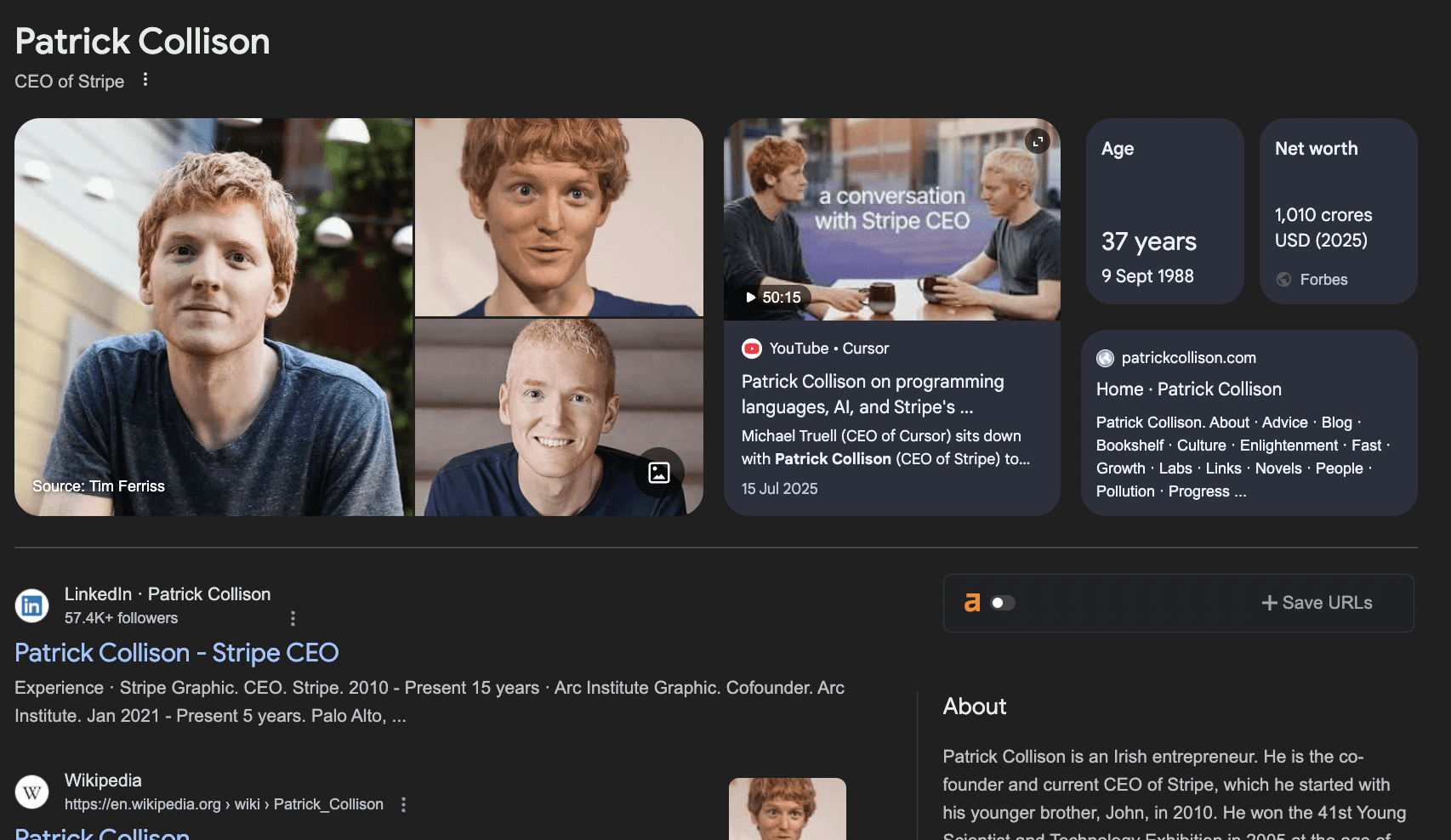
If your search results are a patchwork of old projects, stale side hustle profiles, and generic listings, it sends a confusing signal. Have you really built what the article claims, or are you still in an experimental phase. If, on the other hand, Google presents a clear Knowledge Panel with your name, role, company, and coherent story, the impression changes. You feel like a known quantity, even to strangers.

Why a Knowledge Panel matters in a post raise phase

A Knowledge Panel is not a trophy. It is a compression layer. It takes the chaos of your online footprint and turns it into a digestible summary. After a fundraising announcement, that summary starts doing real work.

Think about early senior hires. The best people you want already have options. They will glance at your funding announcement, then they will check who you are. If they see a panel that reflects a serious operator with a visible presence, they are much more likely to take your call and bring their spouse or mentor on board. The sense that you are a real, trackable entity de risks the move.

Think about future rounds. By the time you speak to growth stage funds, you are not a brand new name. Analysts and partners will already have formed an informal picture based on what they could find. A clean panel is a way to make sure that picture is built from aligned, up to date information.

Think about customers. In many categories, buyers cannot read your code or inspect your infrastructure. They rely on a mixture of brand, references, and what they can quickly gather about the leadership. Seeing you framed as an entity that Google recognises creates a different emotional response compared to seeing a cluttered mix of student projects and freelancer profiles.

The mismatch between being a real founder and looking like one online

Most founders focus correctly on product, team, distribution, and capital. Cleaning up their own name search and pushing it toward entity status feels cosmetic or self absorbed. As a result, you can have a founder who has just closed a solid seed or Series A, with teams and customers, still represented online as a random individual whose primary visible identity is a three year old personal blog.

The irony is that many smaller, less operationally impressive people in adjacent spaces do have panels, simply because their online presence matches the pattern the system expects. They have book listings, podcast appearances, structured profiles, or public data that is easy for Google to ingest.

This is not about fairness. It is about legibility. The investor who wrote your check knows you are the real thing. The market at large, and the machines that power search and AI, can only act on signals.

Shaping the entity that everyone is about to query

You cannot walk into every room and explain your story yourself. What you can do is shape the way your name appears in the system that most of those rooms secretly consult.

For a founder who has just raised, there are a few key moves:

  • Make sure the way your name, role, and company are written is consistent across the web

  • Consolidate or retire outdated profiles that confuse the picture

  • Strengthen a small number of high trust sources that speak about you, rather than scatter energy across dozens of weak ones

  • Where appropriate, make sure the right structured data tells Google that these sources are about the same person

When those pieces line up, Google is more likely to promote your presence into a Knowledge Panel. Once that happens, anyone who looks you up after seeing your round sees a curated, reliable snapshot instead of a random collage.

Use the fundraise moment to upgrade your default search

A funding announcement already causes a temporary spike in attention. That spike is going to happen whether you prepare for it or not. The names of your investors, your company, and you as a founder will be searched more in that window than ever before.

Treat that moment as a forcing function to make your Google presence match your actual trajectory. A Knowledge Panel is not the only part of that, but it is a tangible, visible milestone. It tells the outside world that you exist not only as a pitch deck and a press release, but as an entity in the infrastructure that underlies search, news, and AI systems.

You have already done the hard part by building something and convincing smart people to fund it. Making sure the default search of your name reflects that reality is a relatively small, high leverage next step.

You Just Announced Your Round. Now Every Stranger Is Googling You

The moment your fundraise hits the wire, the story is no longer fully yours. Your investors share it with their LPs and deal flow groups. Other founders send it to their WhatsApp chats. Candidates see it in their feeds. Journalists fold it into their coverage of the market.

From that point on, one thing happens again and again in the background. People type your name into Google.

Some of them are excited and curious. Some are doing risk checks. Some are simply trying to decide whether this is a story worth watching. You are the protagonist of that story. Your company site and TechCrunch article are part of it, but your personal search page is the layer that makes people feel either confident or uneasy.

Fundraising turns your name into a search term

Before your round, most people searching for your name were people who already had some context. Classmates, early users, people in small circles. After the announcement, your name is treated as an object of due diligence.

Potential hires search you before responding to your recruiter. Enterprise buyers search you before betting on your roadmap. Other investors search you when a scout sends them your deck. That search is fast and shallow. Nobody is reading ten pages deep. They are scanning the first screen and building a subconscious verdict.

If your search results are a patchwork of old projects, stale side hustle profiles, and generic listings, it sends a confusing signal. Have you really built what the article claims, or are you still in an experimental phase. If, on the other hand, Google presents a clear Knowledge Panel with your name, role, company, and coherent story, the impression changes. You feel like a known quantity, even to strangers.

Why a Knowledge Panel matters in a post raise phase

A Knowledge Panel is not a trophy. It is a compression layer. It takes the chaos of your online footprint and turns it into a digestible summary. After a fundraising announcement, that summary starts doing real work.

Think about early senior hires. The best people you want already have options. They will glance at your funding announcement, then they will check who you are. If they see a panel that reflects a serious operator with a visible presence, they are much more likely to take your call and bring their spouse or mentor on board. The sense that you are a real, trackable entity de risks the move.

Think about future rounds. By the time you speak to growth stage funds, you are not a brand new name. Analysts and partners will already have formed an informal picture based on what they could find. A clean panel is a way to make sure that picture is built from aligned, up to date information.

Think about customers. In many categories, buyers cannot read your code or inspect your infrastructure. They rely on a mixture of brand, references, and what they can quickly gather about the leadership. Seeing you framed as an entity that Google recognises creates a different emotional response compared to seeing a cluttered mix of student projects and freelancer profiles.

The mismatch between being a real founder and looking like one online

Most founders focus correctly on product, team, distribution, and capital. Cleaning up their own name search and pushing it toward entity status feels cosmetic or self absorbed. As a result, you can have a founder who has just closed a solid seed or Series A, with teams and customers, still represented online as a random individual whose primary visible identity is a three year old personal blog.

The irony is that many smaller, less operationally impressive people in adjacent spaces do have panels, simply because their online presence matches the pattern the system expects. They have book listings, podcast appearances, structured profiles, or public data that is easy for Google to ingest.

This is not about fairness. It is about legibility. The investor who wrote your check knows you are the real thing. The market at large, and the machines that power search and AI, can only act on signals.

Shaping the entity that everyone is about to query

You cannot walk into every room and explain your story yourself. What you can do is shape the way your name appears in the system that most of those rooms secretly consult.

For a founder who has just raised, there are a few key moves:

  • Make sure the way your name, role, and company are written is consistent across the web

  • Consolidate or retire outdated profiles that confuse the picture

  • Strengthen a small number of high trust sources that speak about you, rather than scatter energy across dozens of weak ones

  • Where appropriate, make sure the right structured data tells Google that these sources are about the same person

When those pieces line up, Google is more likely to promote your presence into a Knowledge Panel. Once that happens, anyone who looks you up after seeing your round sees a curated, reliable snapshot instead of a random collage.

Use the fundraise moment to upgrade your default search

A funding announcement already causes a temporary spike in attention. That spike is going to happen whether you prepare for it or not. The names of your investors, your company, and you as a founder will be searched more in that window than ever before.

Treat that moment as a forcing function to make your Google presence match your actual trajectory. A Knowledge Panel is not the only part of that, but it is a tangible, visible milestone. It tells the outside world that you exist not only as a pitch deck and a press release, but as an entity in the infrastructure that underlies search, news, and AI systems.

You have already done the hard part by building something and convincing smart people to fund it. Making sure the default search of your name reflects that reality is a relatively small, high leverage next step.

You Just Announced Your Round. Now Every Stranger Is Googling You

The moment your fundraise hits the wire, the story is no longer fully yours. Your investors share it with their LPs and deal flow groups. Other founders send it to their WhatsApp chats. Candidates see it in their feeds. Journalists fold it into their coverage of the market.

From that point on, one thing happens again and again in the background. People type your name into Google.

Some of them are excited and curious. Some are doing risk checks. Some are simply trying to decide whether this is a story worth watching. You are the protagonist of that story. Your company site and TechCrunch article are part of it, but your personal search page is the layer that makes people feel either confident or uneasy.

Fundraising turns your name into a search term

Before your round, most people searching for your name were people who already had some context. Classmates, early users, people in small circles. After the announcement, your name is treated as an object of due diligence.

Potential hires search you before responding to your recruiter. Enterprise buyers search you before betting on your roadmap. Other investors search you when a scout sends them your deck. That search is fast and shallow. Nobody is reading ten pages deep. They are scanning the first screen and building a subconscious verdict.

If your search results are a patchwork of old projects, stale side hustle profiles, and generic listings, it sends a confusing signal. Have you really built what the article claims, or are you still in an experimental phase. If, on the other hand, Google presents a clear Knowledge Panel with your name, role, company, and coherent story, the impression changes. You feel like a known quantity, even to strangers.

Why a Knowledge Panel matters in a post raise phase

A Knowledge Panel is not a trophy. It is a compression layer. It takes the chaos of your online footprint and turns it into a digestible summary. After a fundraising announcement, that summary starts doing real work.

Think about early senior hires. The best people you want already have options. They will glance at your funding announcement, then they will check who you are. If they see a panel that reflects a serious operator with a visible presence, they are much more likely to take your call and bring their spouse or mentor on board. The sense that you are a real, trackable entity de risks the move.

Think about future rounds. By the time you speak to growth stage funds, you are not a brand new name. Analysts and partners will already have formed an informal picture based on what they could find. A clean panel is a way to make sure that picture is built from aligned, up to date information.

Think about customers. In many categories, buyers cannot read your code or inspect your infrastructure. They rely on a mixture of brand, references, and what they can quickly gather about the leadership. Seeing you framed as an entity that Google recognises creates a different emotional response compared to seeing a cluttered mix of student projects and freelancer profiles.

The mismatch between being a real founder and looking like one online

Most founders focus correctly on product, team, distribution, and capital. Cleaning up their own name search and pushing it toward entity status feels cosmetic or self absorbed. As a result, you can have a founder who has just closed a solid seed or Series A, with teams and customers, still represented online as a random individual whose primary visible identity is a three year old personal blog.

The irony is that many smaller, less operationally impressive people in adjacent spaces do have panels, simply because their online presence matches the pattern the system expects. They have book listings, podcast appearances, structured profiles, or public data that is easy for Google to ingest.

This is not about fairness. It is about legibility. The investor who wrote your check knows you are the real thing. The market at large, and the machines that power search and AI, can only act on signals.

Shaping the entity that everyone is about to query

You cannot walk into every room and explain your story yourself. What you can do is shape the way your name appears in the system that most of those rooms secretly consult.

For a founder who has just raised, there are a few key moves:

  • Make sure the way your name, role, and company are written is consistent across the web

  • Consolidate or retire outdated profiles that confuse the picture

  • Strengthen a small number of high trust sources that speak about you, rather than scatter energy across dozens of weak ones

  • Where appropriate, make sure the right structured data tells Google that these sources are about the same person

When those pieces line up, Google is more likely to promote your presence into a Knowledge Panel. Once that happens, anyone who looks you up after seeing your round sees a curated, reliable snapshot instead of a random collage.

Use the fundraise moment to upgrade your default search

A funding announcement already causes a temporary spike in attention. That spike is going to happen whether you prepare for it or not. The names of your investors, your company, and you as a founder will be searched more in that window than ever before.

Treat that moment as a forcing function to make your Google presence match your actual trajectory. A Knowledge Panel is not the only part of that, but it is a tangible, visible milestone. It tells the outside world that you exist not only as a pitch deck and a press release, but as an entity in the infrastructure that underlies search, news, and AI systems.

You have already done the hard part by building something and convincing smart people to fund it. Making sure the default search of your name reflects that reality is a relatively small, high leverage next step.

Abhay Jain

Founder and CEO

Abhay Jain is the Founder and CEO of Lindy GEO and Lindy Panels.

Abhay Jain

Founder and CEO

Abhay Jain is the Founder and CEO of Lindy GEO and Lindy Panels.

Ready to look like someone who matters?

Turn your Google presence into a polished Knowledge Panel that signals credibility to clients, investors and press before you ever walk in the room.

Ready to look like someone who matters?

Turn your Google presence into a polished Knowledge Panel that signals credibility to clients, investors and press before you ever walk in the room.

Ready to look like someone who matters?

Turn your Google presence into a polished Knowledge Panel that signals credibility to clients, investors and press before you ever walk in the room.

Latest posts

Discover other pieces of writing in our blog

Best-in class ORM for Individuals and Companies

Copyright © Lindy GEO Technologies LLP. All rights reserved

Best-in class ORM for Individuals and Companies

Copyright © Lindy GEO Technologies LLP. All rights reserved